


If you are shopping for a 1990s 80 Series, you will run into the same question on every forum thread: is the Lexus LX450 just a Land Cruiser with a nicer badge, or is it a different truck? The short version is that the LX450 and the FZJ80 share the body, frame, 4.5-liter 1FZ-FE engine, four-speed automatic and full-time four-wheel drive. Lexus changed the grille, the cladding, the interior and the shock tuning, and sold it for about $7,000 more when new. Today the Lexus often sells for less than the Toyota.
We import, service and sell 80 Series Land Cruisers from Japan and the US at our San Diego store, so we see both versions on the lift. This guide compares them point by point, gives you 2026 price ranges with sources, lists the problems to check on either truck, and explains the third option most buyers forget: a Japanese-market Land Cruiser 80 that has now cleared the 25-year import rule.
If you want the broader picture first, our Lexus LX vs Land Cruiser comparison covers every generation from the LX450 to the LX 600. This article stays on the 80 Series.
- Quick Answer: LX450 vs FZJ80 at a Glance
- Why the Lexus LX450 and the FZJ80 Are the Same Truck
- 80 Series Model Years Explained: FJ80 vs FZJ80 vs LX450
- Key Differences That Matter to Buyers
- LX450 vs FZJ80 Prices in 2026: What Each One Costs
- Reliability and Common Problems on Both Trucks
- Which One Should You Buy? Four Buyer Profiles
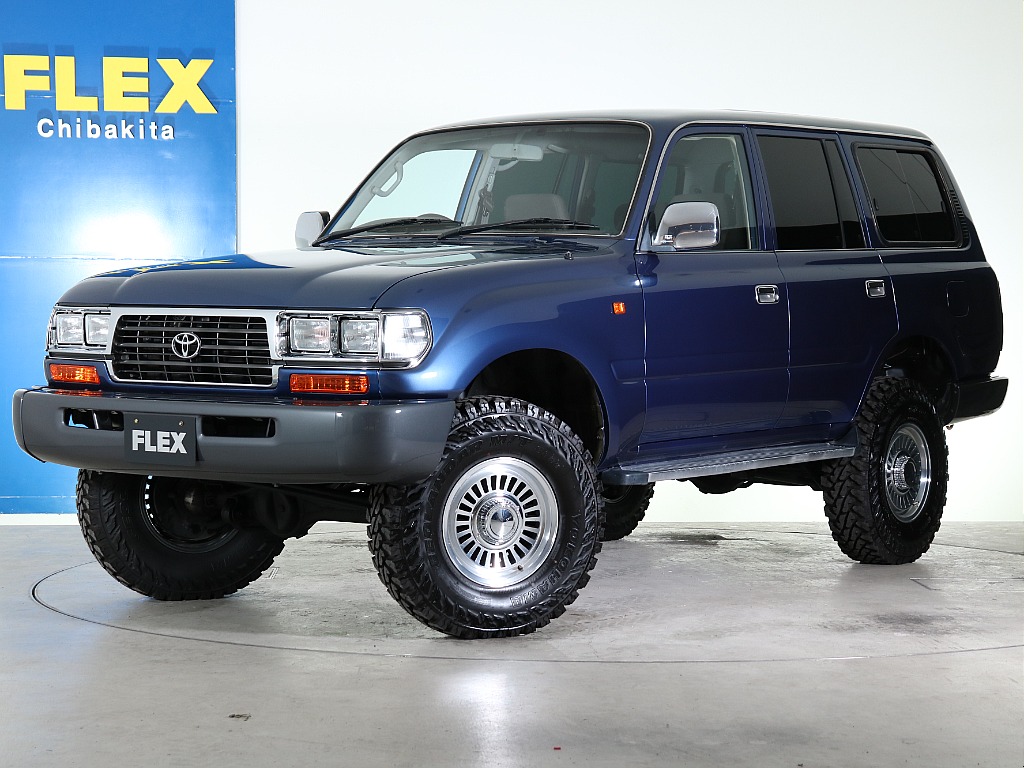
- The Third Option: A JDM Land Cruiser 80 From Japan
- Used LX450 and FZJ80 Inspection Checklist
- FAQs
Quick Answer: LX450 vs FZJ80 at a Glance
The table below is the whole comparison in one screen. Everything under the body is shared; the differences are trim, tuning and what the market charges for each badge today.
| 1993–1997 Toyota Land Cruiser (FZJ80) | 1996–1997 Lexus LX450 | |
|---|---|---|
| Engine | 4.5 L 1FZ-FE inline-six, 212 hp / 275 lb-ft | Same |
| Transmission / 4WD | 4-speed electronic automatic, full-time 4WD, 2-speed transfer with center lock | Same |
| Front and rear lockers | Optional from 1993, never standard | Optional ($900 when new) |
| Seats | 5 standard, 7 with the Third Seat Package | 7 standard |
| Interior | Cloth standard; leather, moonroof and third row optional (wood dash was a dealer-installed accessory) | Leather, wood trim, automatic climate control and privacy glass standard |
| Suspension | Toyota tune | Same springs, different shocks, softer ride |
| Curb weight | 4,751 lb (4,850 lb with third row) | 4,971 lb |
| Towing | 5,000 lb | 5,000 lb |
| Base MSRP when new | $40,258 (1996), $41,068–$41,188 (1997, depending on source) | $47,995 (1996), $48,945 (1997), delivery included |
| US sales | About 74,700 Land Cruisers across 1991–1997 | 7,528 (1996) and 6,785 (1997) |
| 2026 auction range, driver to excellent | Roughly $18,000–$37,000, special editions higher | Roughly $16,000–$27,000, best examples $33,000–$37,000 |
Our take: if you want the plushest 80 Series for the least money, buy an LX450. If you want factory lockers, a cloth interior that shrugs off dogs and mud, or a Collector’s Edition or 40th Anniversary truck that holds its value, buy an FZJ80. If you want a diesel, a five-speed manual or lower mileage, look at a Japanese-market 80.
Why the Lexus LX450 and the FZJ80 Are the Same Truck
Lexus announced the LX450 in 1995 and put it on sale in January 1996. It was the brand’s first SUV, and it was built alongside the Land Cruiser with the same body, frame, engine, transmission and electrical systems. A period road test summed it up: the only differences were grilles, nameplates, suspension spring rates and option packages.
Shared Platform, 1FZ-FE Engine and Drivetrain
Both trucks use the 4.5-liter, 24-valve, twin-cam 1FZ-FE inline-six rated at 212 horsepower at 4,600 rpm and 275 lb-ft of torque at 3,200 rpm. Toyota’s 1997 dealer product guide and the Lexus 1996 and 1997 specification sheets list identical numbers, and we found no source showing a power change between 1993 and 1997 on US trucks.
The rest of the hardware matches too. Both run a four-speed electronically controlled automatic with a second-gear start switch and a transmission cooler, a two-speed transfer case with a viscous-coupling center differential and a center lock, 4.10:1 axle gears, solid axles front and rear on coil springs, recirculating-ball steering, and four-wheel vented disc brakes with ABS. Wheelbase is 112.2 inches, length 189.8 inches, width 76.0 inches and ground clearance 10.8 inches, and the fuel tank holds 25.1 gallons on both. Both are rated to tow 5,000 pounds.
Fuel economy is the same as well. The original window stickers said 13 city / 15 highway for both trucks, and the EPA’s revised figures on fueleconomy.gov now show 12 city / 14 highway / 13 combined for the 1995–1997 Land Cruiser and the 1996–1997 LX450.
What Lexus Changed for the LX450 (1996–1997)
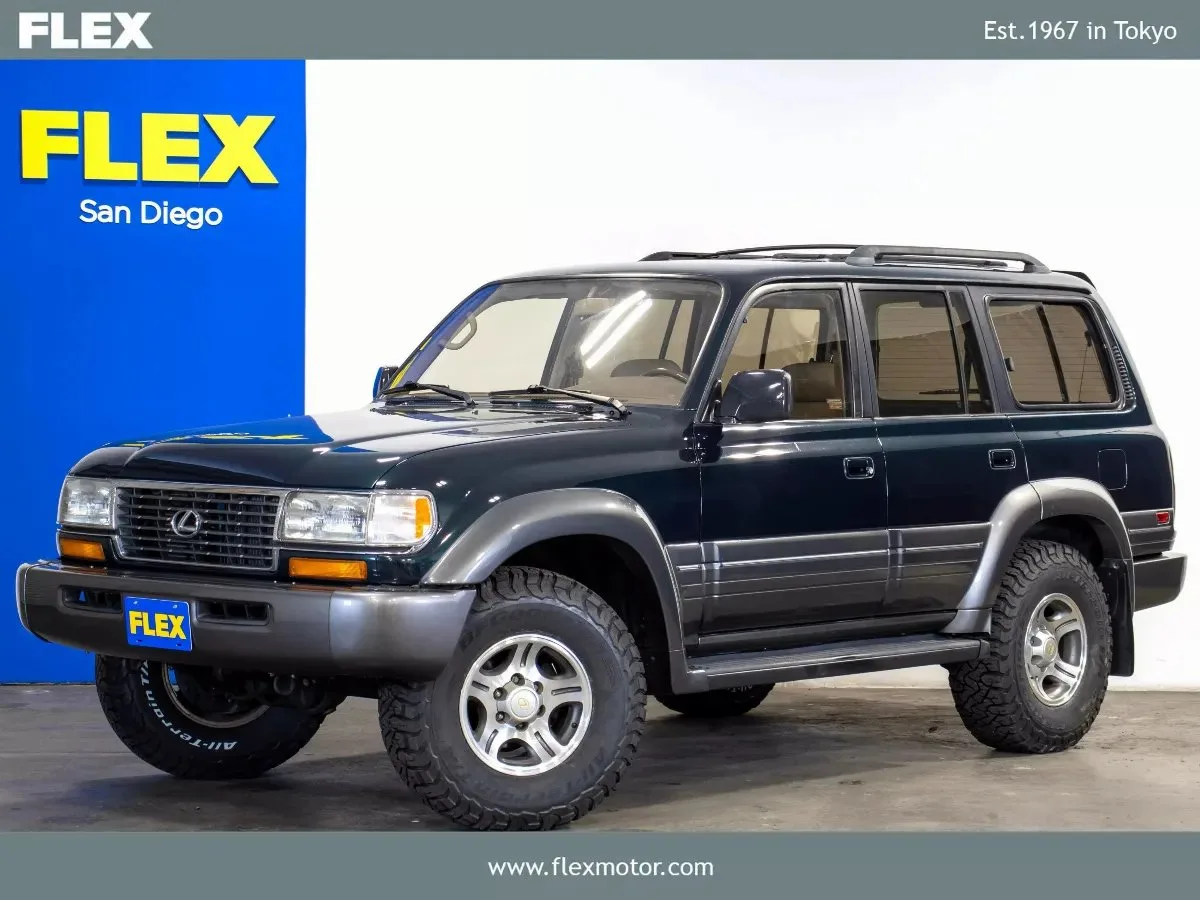
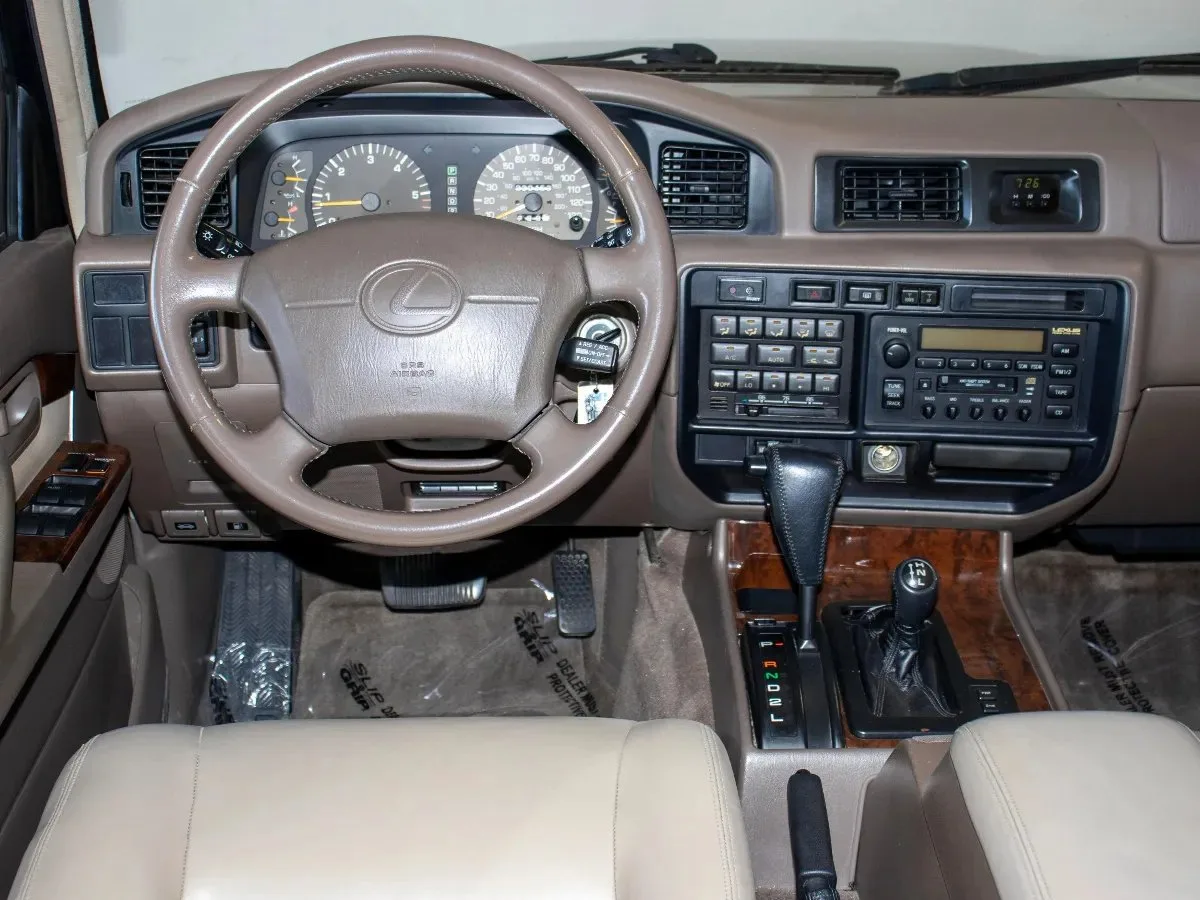
Lexus gave the LX450 its own grille and headlamps, plastic body cladding with integrated fender flares, 16-inch alloy wheels with a matching alloy spare, and a short list of standard equipment the Toyota only offered as options: leather seats and door panels, simulated wood trim, automatic climate control, privacy glass and three rows of seats. The audio system moved to a seven-speaker setup with an optional six-disc changer in the console, while the Land Cruiser kept its nine-speaker system.
The suspension was recalibrated for a softer ride. According to a long-time moderator on the IH8MUD forum, the LX450 coil springs carry the same part numbers as the 1996–1997 Land Cruiser springs, and it is the shock absorbers that differ. Owners describe the LX as quieter and more car-like, though whether it has more sound deadening is debated.
The LX450 came in five colors, Champagne Pearl, Cashmere Beige Metallic, Dark Emerald Pearl, White and Black Onyx, and had just three factory options: the console CD changer at $1,050, front and rear locking differentials at $900, and a power moonroof at $1,300. Lexus built 5,398 units for model year 1996 and 9,186 for 1997, and US calendar-year sales were 7,528 in 1996 and 6,785 in 1997 before the V8-powered LX 470 replaced it.
80 Series Model Years Explained: FJ80 vs FZJ80 vs LX450
The 80 Series arrived in the US in spring 1990 as a 1991 model. The nameplate on the tailgate stayed the same through 1997, but the truck underneath changed enough that model year matters. Our 80 Series Land Cruiser Buying Guide covers each year in depth, so this is the short version.
1991–1992 FJ80: The 3F-E Era
The first US 80s used the 4.0-liter 3F-E pushrod six with 155 horsepower and 220 lb-ft, paired with a fully hydraulic A440F four-speed automatic. Full-time four-wheel drive with a locking center differential was standard from the start. Front and rear differential locks were not offered on US trucks in these years, and power locks, windows and mirrors became standard for 1992. Values sit well below the later trucks: Hagerty notes a 35% gap, about $13,000, between a 1992 and a 1993 in the same condition as of October 2026, attributed to the engine alone.
1993–1994 FZJ80: The 1FZ-FE Arrives
For 1993 Toyota fitted the 212-horsepower 1FZ-FE, added electronic transmission control, and made front and rear differential locks and ABS with rear disc brakes available as options. These are the first “triple-locked” 80s, and the ones most often reported with head gasket trouble, which we cover below. The 1994 trucks gained a nine-speaker stereo.
1995–1997 FZJ80 and LX450: Airbags, OBD-II and the Final Years
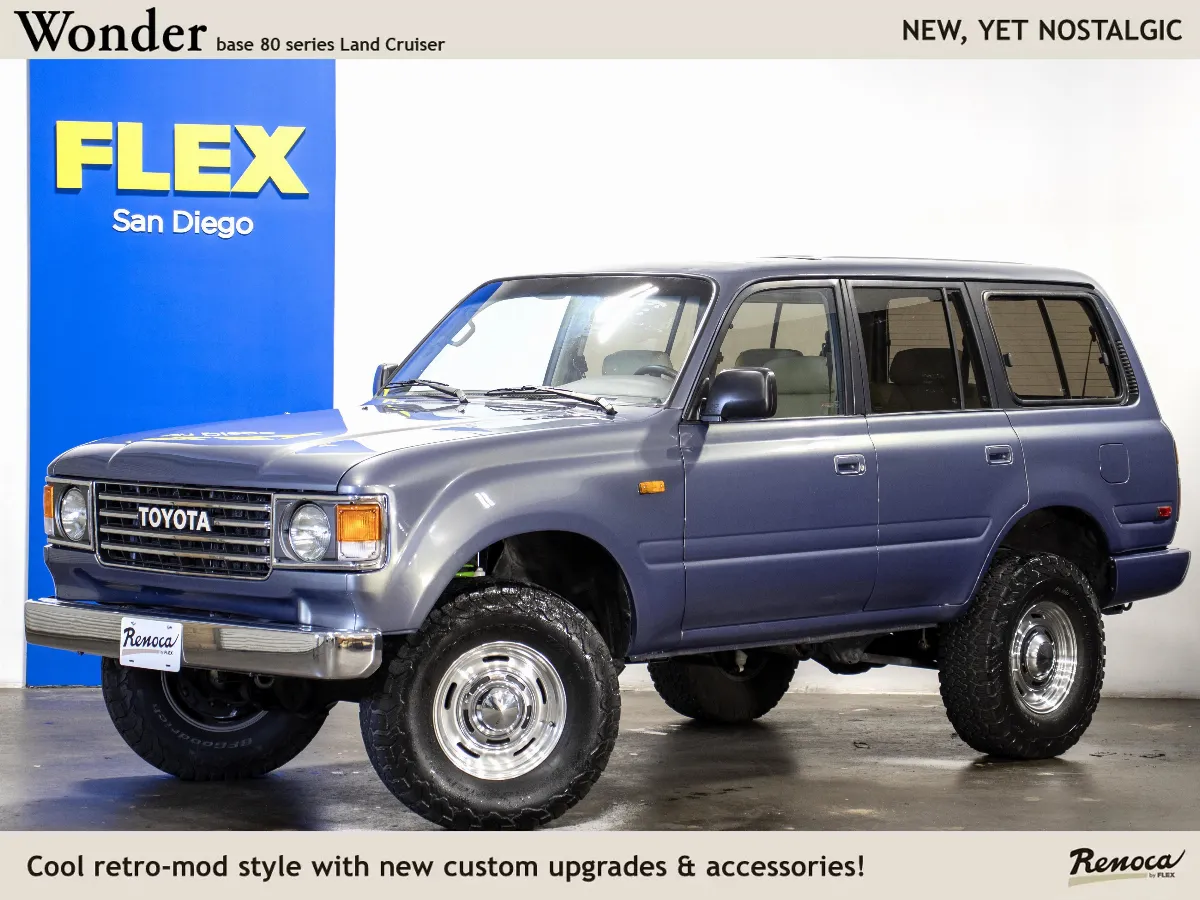
A mid-1995 update brought dual airbags, standard ABS and a new grille with the Toyota emblem. Owners also point to a redesigned dash, plastic fender flares, an aluminum radiator and the A343F transmission arriving with the 1995 trucks. The 1996 model year is the first fully OBD-II compliant 80 Series, which simplifies emissions testing and diagnostics. The LX450 joined the line for 1996 with all of these updates built in.
Toyota called the 1997 Land Cruiser “essentially unchanged”, then added two send-off packages: the Collector’s Edition, a $7,745 bundle of leather, moonroof, premium audio, alloy wheels and special badging, and the serialized 40th Anniversary Limited Edition in Antique Sage Pearl or Dark Emerald Pearl with two-tone leather. US production of the 80 Series ended with the 1997 model year, and the 100 Series with its 4.7-liter V8 and independent front suspension arrived for 1998.
Key Differences That Matter to Buyers
Each difference below is small on paper. What matters is what it means when you are standing in front of a 30-year-old truck with a checkbook.
Interior, Trim and Equipment
Inside, an LX450 is what a fully optioned Land Cruiser would have been. Leather seats and door inserts, wood-grain trim, power front seats, automatic climate control and the third-row jump seats were all standard. A base Land Cruiser came with cloth seats, five seats and manual climate control; the Leather-trim Package alone was about $4,280 in 1997, and the Third Seat Package was a separate option.
For a used buyer, that means two things. An LX450 interior is nicer to live with and easier to find in good condition, because nearly all of them were ordered the same way. A Land Cruiser interior is easier to clean after a weekend of dogs and sand, and the cloth holds up better than 30-year-old leather. If you find a Collector’s Edition or 40th Anniversary truck, you get the Lexus-level interior with the Toyota badge.
Suspension, Ride and Towing
The LX450’s softer shock tuning makes it the more comfortable highway truck. Both are rated to tow 5,000 pounds, both have a transmission cooler and trailer wiring from the factory, and both weigh around two and a half tons, so towing manners are the same once you add a weight-distributing hitch.
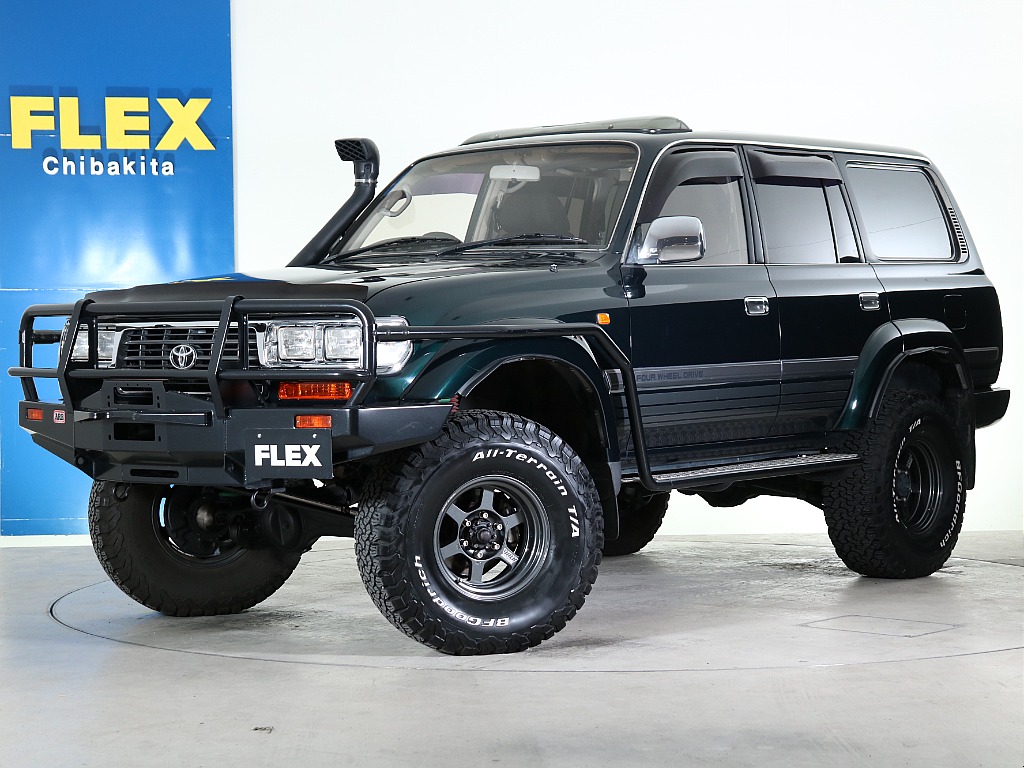
Most owners who build an LX450 for off-road use replace the shocks and springs anyway, and aftermarket suspension listed for the Land Cruiser fits the Lexus. If you plan to lift the truck, the factory shock difference stops mattering.
Factory Locking Differentials: Who Got Them
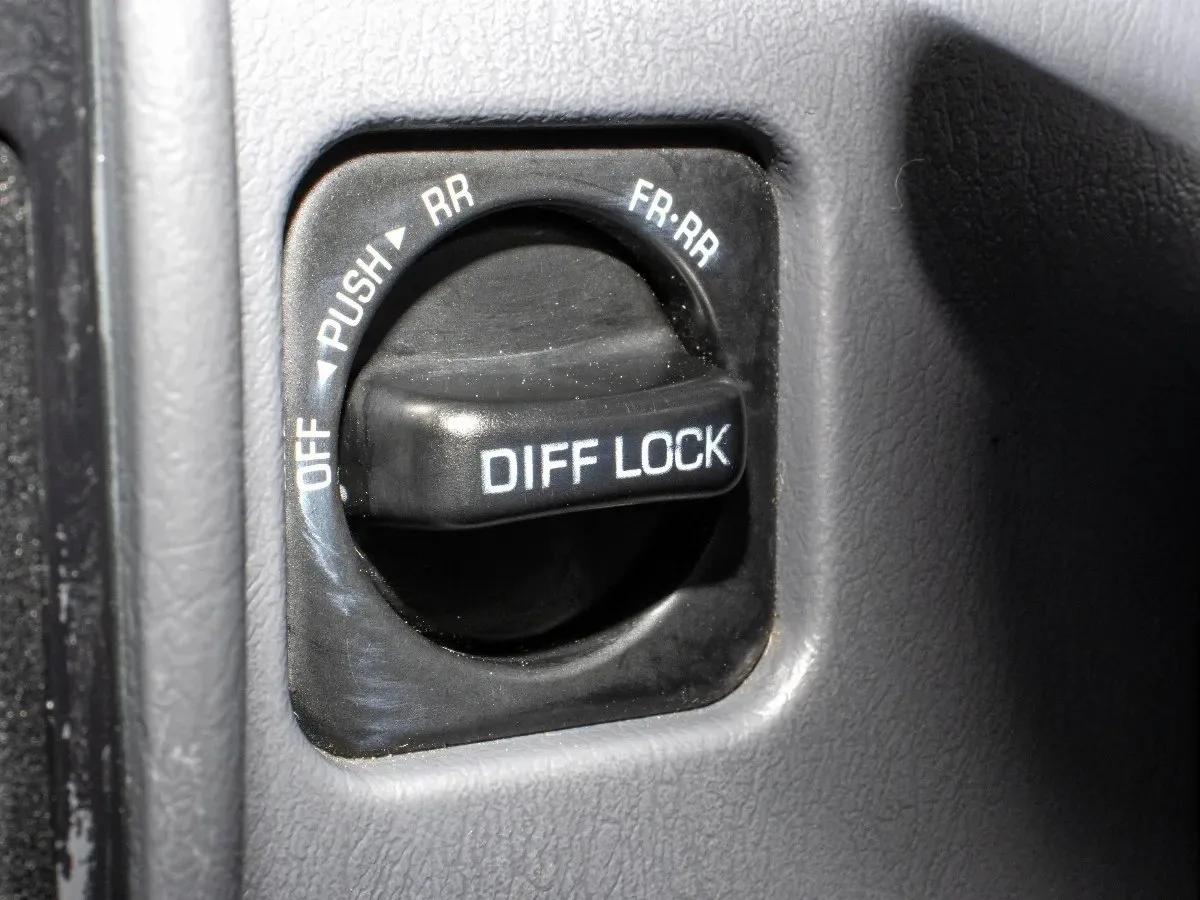
This is the point where forum lore and the factory paperwork disagree, so here is what the documents say. Toyota’s 1997 Land Cruiser dealer product guide lists “Front and rear differential locks” as an option, code DL. The Lexus 1996 and 1997 specification sheets list the same option at $900. Lockers were never standard on any US 80 Series or LX450, and they were not offered at all on the 1991–1992 trucks. Any claim that lockers became standard “from 1994” or were available “on 1990 models” does not match Toyota’s own documents.
Owner-compiled figures suggest roughly a third of 1997 Land Cruisers left the factory with lockers, so a triple-locked truck is worth looking for and paying for. Check for the dial to the left of the steering wheel and the actuators on the differentials themselves, because the switch alone can be added to an unlocked truck.
Styling: Grille, Badges, Wheels and Running Boards
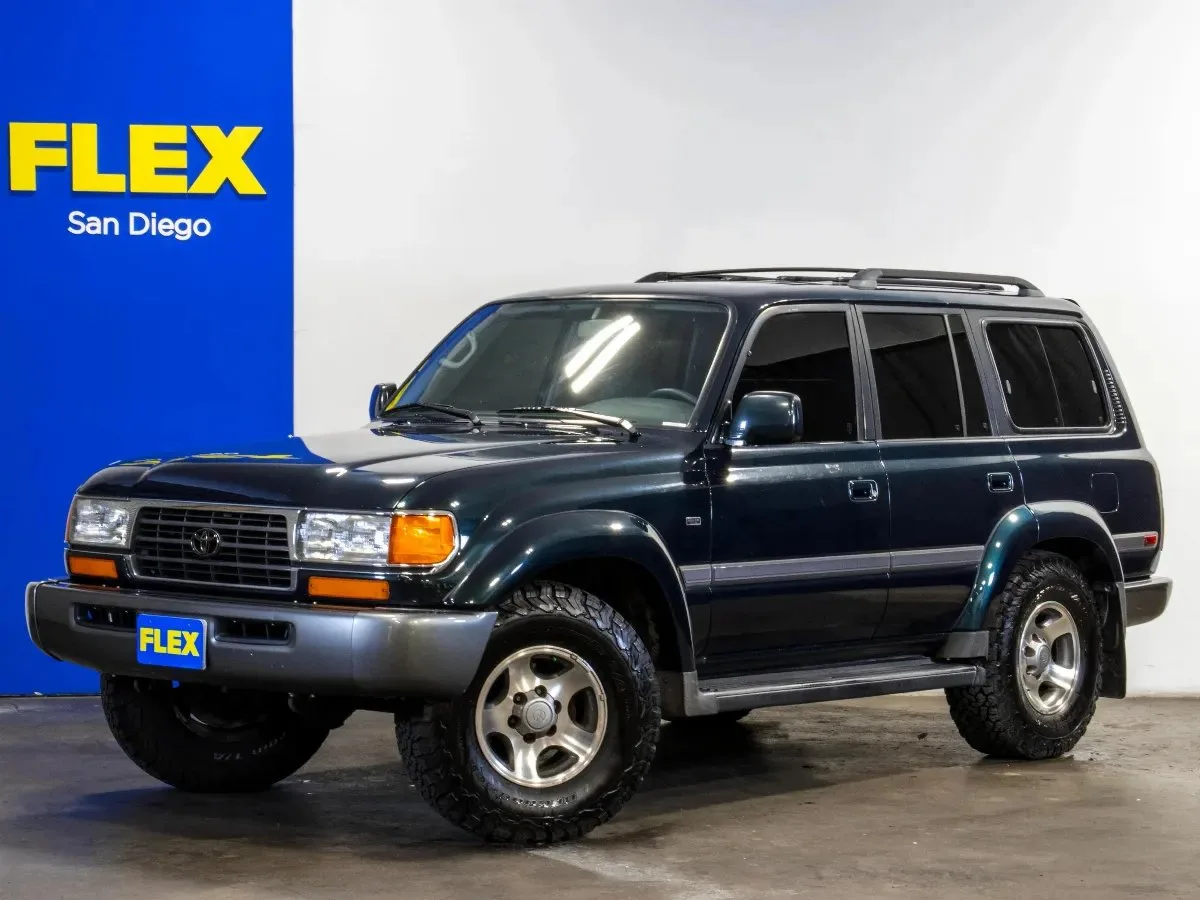
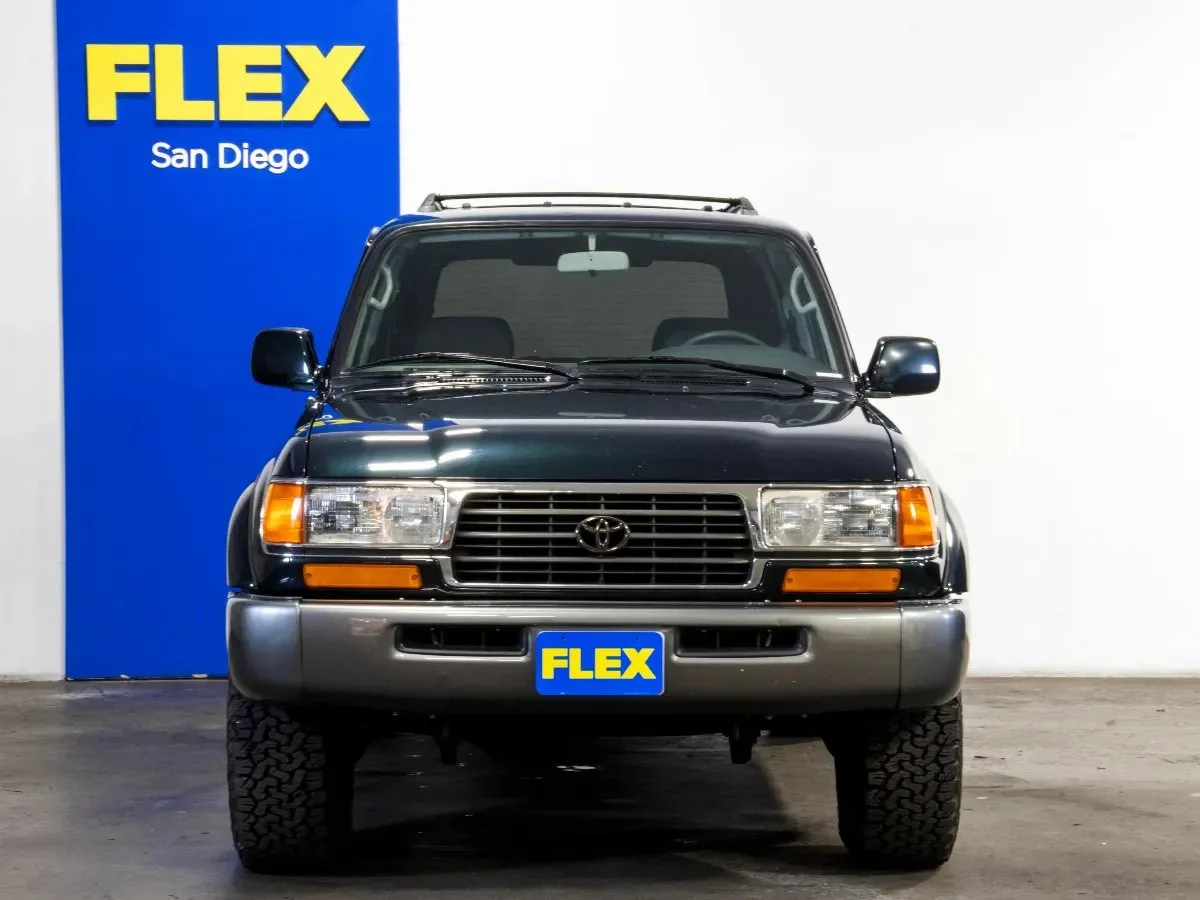
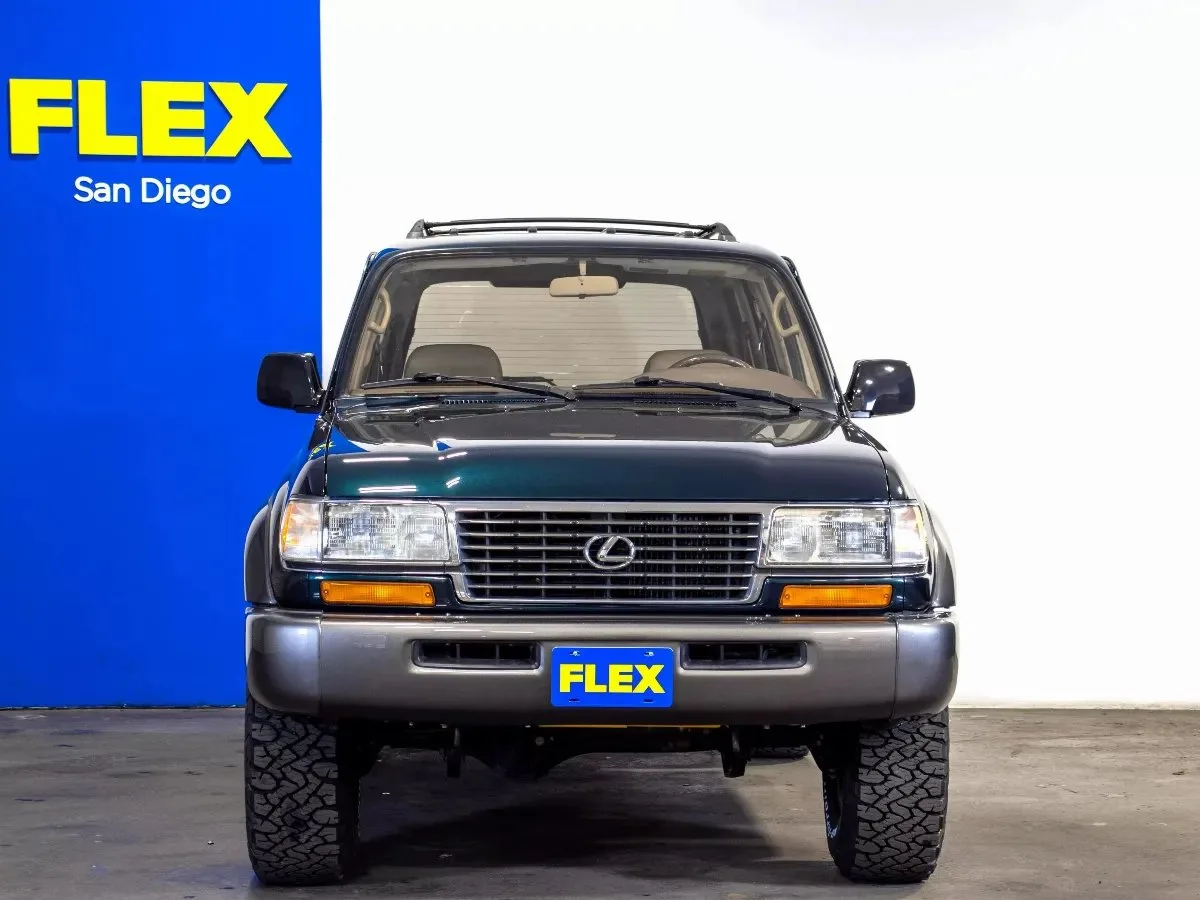
From the outside, the LX450 shows a Lexus grille and headlamps, body-colored cladding and flares, different alloy wheels and center caps, two-tone mud flaps and a bronze windshield tint instead of the Toyota’s blue, according to owners on IH8MUD. Owners also note that 1997 LX450s usually carry color-matched running boards and a roof rack, which were a $1,300 accessory package on the 1996 truck, while on the Land Cruiser both were dealer-installed accessories. Under all of that the sheet metal is identical.
Parts, Service and Insurance
Mechanical parts carry the same Toyota part numbers, so any shop that knows an 80 Series can service an LX450, and the cost of a head gasket or a knuckle rebuild is the same. The Lexus-only pieces are the ones that hurt: headlights, grille, cladding, flares, wheels, seat foam and leather, console trim, keys and the Lexus-specific service manual. Owners report these are dealer-only items that Toyota parts counters often cannot source, and they cost more. If you buy an LX450, buy one with straight cladding and good headlights.
LX450 vs FZJ80 Prices in 2026: What Each One Costs
The 80 Series has become a collector truck. Hagerty has tracked more than 600 sales in ten years and reports that a concours 1997 Land Cruiser can bring $172,000, with excellent examples around $61,000 and good drivers around $21,000, as of October 2026. Most trucks still trade well under $30,000.
Auction and Dealer Prices
The ranges below come from Bring a Trailer results over the past twelve months as mirrored by Classic.com, Hagerty past sales and The Classic Valuer, plus dealer listings on Cars.com, Edmunds and ClassicCars.com, as of November 9, 2026. We recommend checking the individual lots before you set a budget, because condition swings these numbers more than model year does.
| Condition | 1993–1997 FZJ80 | 1996–1997 LX450 |
|---|---|---|
| Project or rough | $3,000–$8,000 | $8,000–$12,000 |
| Honest driver | $18,000–$26,000 | $16,000–$24,000 |
| Sorted and documented | $30,000–$37,000 | $24,000–$27,000 |
| Exceptional, low miles or special edition | $48,000–$58,000, with outliers above $90,000 | $33,000–$37,000 |
Dealer asking prices track the same pattern. In November 2026 Cars.com showed six LX450s nationwide between $11,999 and $30,775, and 24 Land Cruisers from 1991–1997 mostly between $6,999 and $59,997, with two low-mileage 1996–1997 trucks listed above $90,000.
Our own Land Cruiser 80 listings show prices before shipping and other fees, which vary by your state of residence; use the Get Total Estimate button on each listing for a quote.
Does the Lexus Badge Add Value?
No. On the Classic.com market benchmark the LX450 sits around $22,000 against $27,000–$29,000 for the FZJ80 as of November 2026, roughly 15–20% below the Toyota, and like-for-like 1997 sales in October 2026 put the LX450s in the lower half of the Land Cruiser results. The median across all Bring a Trailer sales tracked by The Classic Valuer is close for both trucks, so the Lexus discount shows up mainly at the top of the market, where Toyota special editions and factory lockers carry the premium. One vendor guide (updated September 2026) puts the value of factory lockers at $5,000–$15,000 over an unlocked truck.
For a buyer, that is the whole argument for the LX450: you get the most expensive version of the 80 Series, when new, at a discount to the plain one today.
Reliability and Common Problems on Both Trucks
Because the mechanical parts are shared, the problem list is shared. None of these are reasons to avoid an 80 Series. They are the items that decide whether a $20,000 truck needs $3,000 or $10,000 of catch-up work. Our Land Cruiser 80 engine history article explains the engines themselves.
1FZ-FE Head Gasket
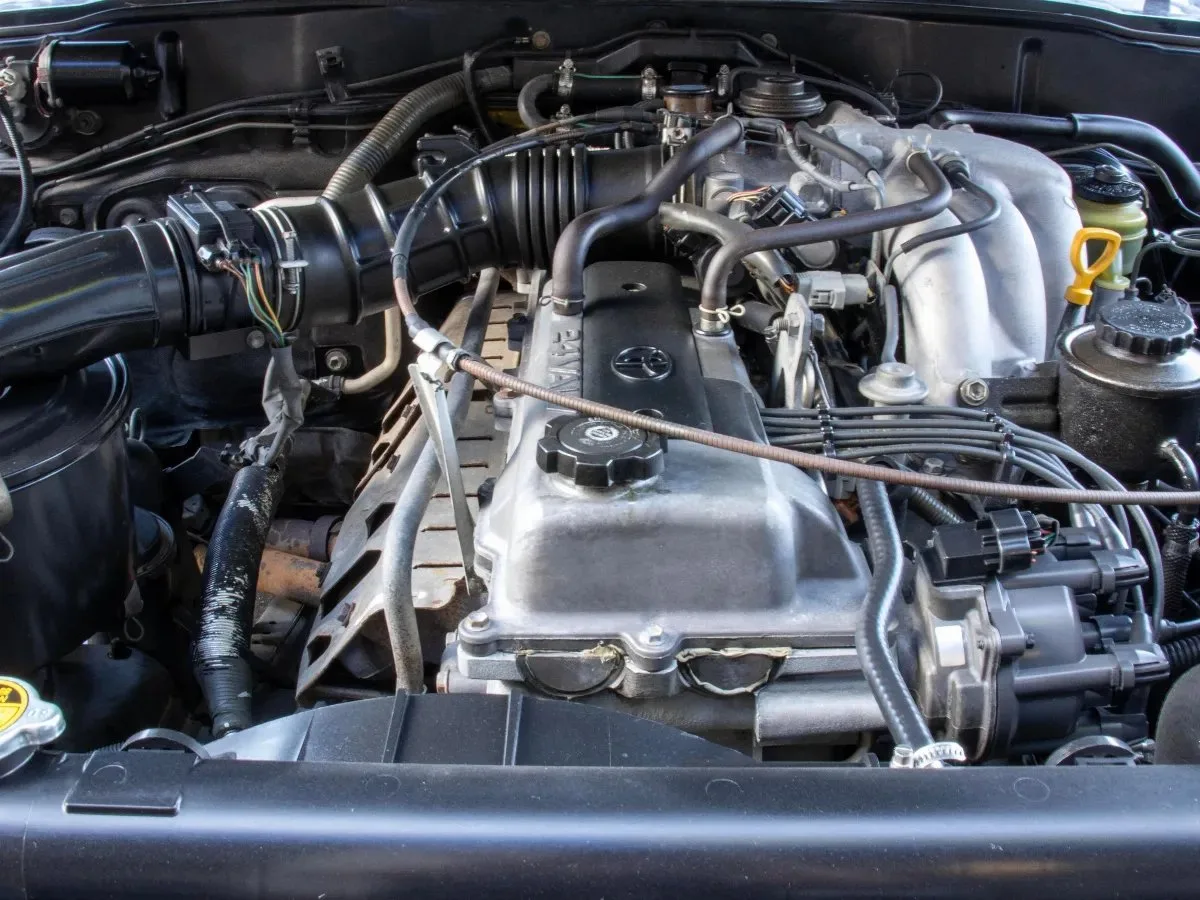
The best-known 80 Series issue. Owners on IH8MUD report head gasket failures most often on 1993–1994 trucks, usually at the rear cylinder, with symptoms of coolant loss without a visible leak, white exhaust smoke and a suspiciously clean number six spark plug. In a 2016 forum poll of 651 owners, 37% said they had experienced a failure. Reported repair costs run from about $1,000 for a do-it-yourself job to $1,500–$3,500 in aggregated estimates and $2,500–$5,500 in a 2026 owner cost guide. We found no Toyota recall or service bulletin for this; it is an owner-reported pattern. A truck with a documented head gasket replacement using the updated gasket is a plus, not a minus.
Rust, Birfields and Knuckles
The front axle uses Birfield joints packed in grease inside the steering knuckles. Over time gear oil contaminates the knuckle grease and grease weeps past the seals, which owners describe as very common. Toyota’s own schedule calls for lubricating the steering knuckles every 15,000 miles and repacking the front wheel bearings every 30,000, and few trucks have seen that. A full knuckle rebuild has been quoted at $800–$1,000 in older forum posts and $1,800–$3,200 in a 2026 owner cost guide, depending on what else is replaced.
Rust is the other structural check. Owners list the factory roof rack mounting points and wind deflector, rear quarter panels and wheel arches, the rear window frame, the last rear crossmember inside the bumper, the spare tire area, and the lower edge of the rear hatch as the places to look. A southwestern truck with surface rust only is worth a premium over a salt-belt truck with a perfect interior.
Cooling System, PHH and Other Known Weak Points
- Pesky heater hose. A short hose between the block and a metal coolant pipe that is hard to reach and fails with age. The part costs around $13; the labor is the cost. Replace it preemptively.
- Radiator. The plastic end tanks split with age, and the internal transmission cooler can leak and mix ATF with coolant. Budget for a new radiator and a full flush if the “pink milkshake” has already happened, and $900–$2,000 for a full cooling-system refresh including the fan clutch, per a 2026 owner cost guide.
- Power steering. Pump and reservoir leaks are common; a pump replacement quote of about $600 is typical, and a steering box can reach $3,000.
- Starter. A single loud click with no crank is usually worn solenoid contacts, a part that costs under $10 and about an hour of work.
- Warning lights. An ABS light is usually a wheel-speed sensor; an airbag light on 1995–1997 trucks is often the clock spring in the steering column.
- Transmission and transfer case. The A343F is regarded as durable, with owners reporting more than 330,000 miles on original units. The viscous coupler in the 1993–1997 transfer case can seize with age, which shows up as driveline binding in tight turns.
High-mileage reports are the reassuring part. Owners on IH8MUD report 1993–1994 trucks past 300,000 miles on original engines, and a 1997 owner on the same forum reports 310,000 miles on the original head gasket. The engine is not the risk. Deferred maintenance is.
🚨 RECALLS: A SHORT LIST
The NHTSA database shows one equipment recall for 1991–1993 Land Cruisers (campaign 93E023000, an aftermarket Reese trailer hitch, 670 units), and no recalls for 1994–1997 Land Cruisers or for the 1996–1997 LX450. Toyota’s period service bulletins cover a thermostat gasket leak on the 1FZ-FE and a coolant-temperature trouble code on 1997 trucks, both minor.
What to do: Enter the 17-digit VIN at the NHTSA recall lookup anyway, and pull an AutoCheck or Carfax report. On a truck this old, the service history matters more than the recall history.
Which One Should You Buy? Four Buyer Profiles
- Overlander or trail driver: FZJ80 with factory lockers, or an LX450 with lockers if you can find one. Plan on new shocks and springs either way, and value lockers over leather. A Japanese-market 80 with the 1HD-FT diesel is the long-range alternative if you live outside California.
- Daily driver or family hauler: LX450. You get the leather, the third row, the automatic climate control and the softer ride for less money than an equivalent Land Cruiser, and the parts under it are the same.
- Collector: 1997 Land Cruiser Collector’s Edition or 40th Anniversary Limited Edition, ideally with lockers and documentation. These are the trucks setting the records.
- Budget buyer: a 1996–1997 LX450 or a 1995–1997 Land Cruiser with a documented head gasket and knuckle service, and honest rust. Spend on condition, not on badge or model year.
The Third Option: A JDM Land Cruiser 80 From Japan
Every 80 Series ever built is now more than 25 years old, which means the Japanese-market versions can be imported to the US without meeting federal safety or emissions standards. Our Used Land Cruiser Buying Guide covers all the generations; here is what matters for the 80.
VX Limited vs US-Spec: Equipment You Didn’t Get Here
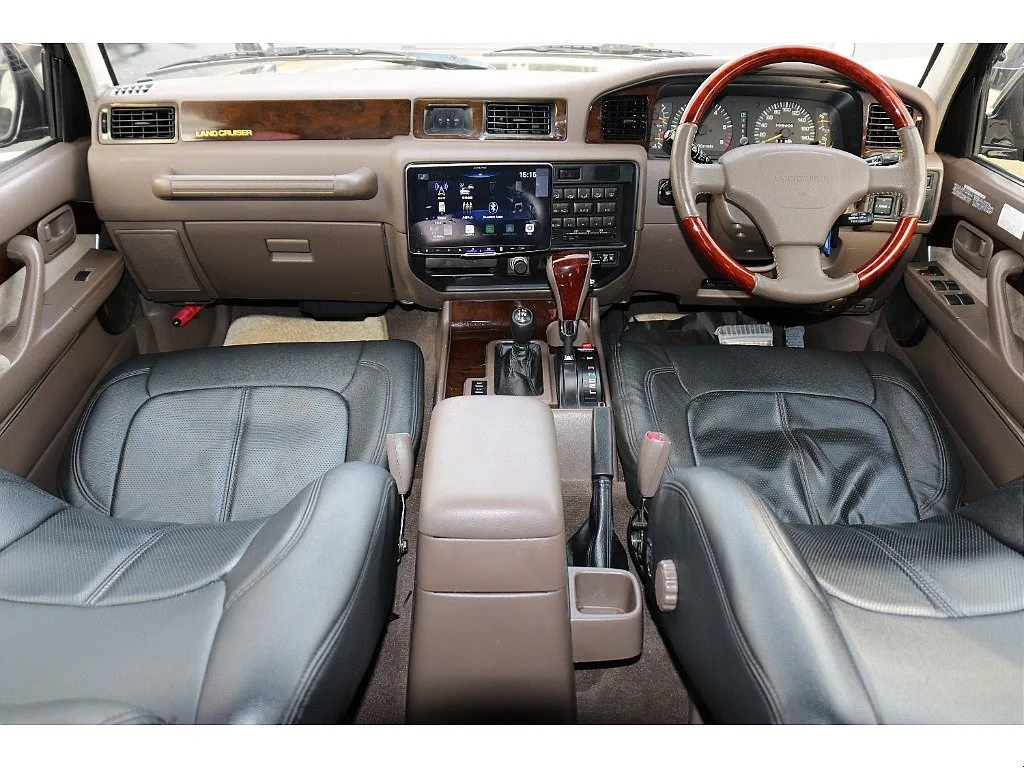
In Japan the 80 Series was sold as an eight-seat station wagon with the gasoline engine and as a five-seat van with diesel engines, in STD, GX, VX and VX Limited grades. The VX Limited was the top of the line from the October 1989 launch, with a nine-speaker CD stereo and cruise control standard. By 1996 the VX Limited came standard with ABS, a driver airbag, fog lamps, alloy wheels, a sunroof, full automatic air conditioning and power everything, with leather and wood trim optional on the wagon and leather standard on the diesel van. Toyota also sold limited packages such as the 1993 VX Limited Special Package, the 1994 Memorial Package, and the 1996 L Package.
Japanese trucks are right-hand drive. No federal standard prohibits right-hand drive, and we are not aware of any state that refuses to register one; the practical adjustments are drive-throughs, toll booths and passing on two-lane roads. Japanese-market examples also tend to have lower mileage than US trucks, in part because Japan’s inspection system pushes owners to replace cars early. As of November 9, 2026, our Land Cruiser 80 inventory shows 24 trucks available, 1991–1997; the 23 Japanese-market trucks are mostly 4.5 VX Limited or 4.2 diesel turbo VX Limited, with odometers from about 23,000 to 160,000 miles.
1HD-T and 1HD-FT Diesel and the 25-Year Rule
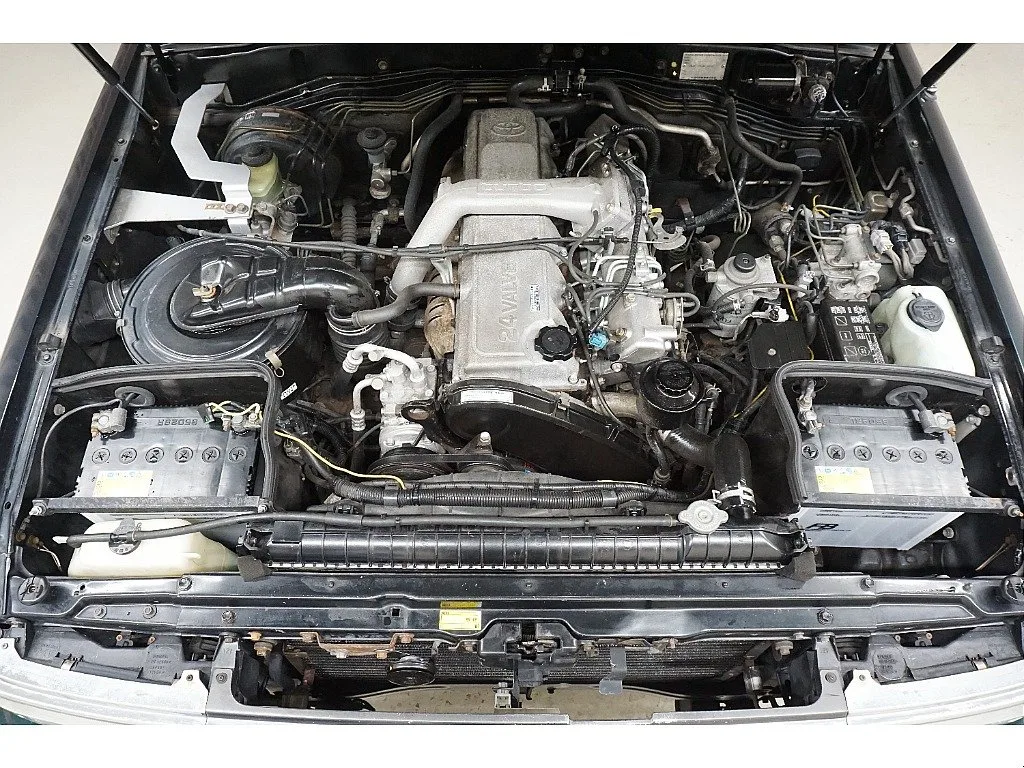
The engine US buyers never got is the 4.2-liter inline-six turbodiesel. The 1HD-T (1989 to January 1995) made 165 PS and 37.0 kg-m, about 268 lb-ft; the 24-valve 1HD-FT that replaced it in January 1995 made 170 PS and 38.7 kg-m, about 280 lb-ft, with a five-speed manual or four-speed automatic. The Japanese 1FZ-FE gasoline wagon was rated at 215 PS. Diesel 80s use a 24-volt starting system, which matters when you shop for batteries and accessories.
The import rule is simple at the federal level. Under 49 CFR 591.5(i), a vehicle that is “25 or more years old” may be imported without meeting Federal Motor Vehicle Safety Standards, and you declare that on DOT form HS-7 by checking Box 1. The EPA side uses form 3520-1 and code E for a vehicle “at least 21 years old” in “original unmodified configuration”. NHTSA counts the 25 years from the date of manufacture, so a truck built in November 2001 or earlier qualifies as of November 2026. Because Toyota lists the 80 Series sales period as ending in January 1998, every one of them qualifies. Customs duty on a passenger vehicle is 2.5%, and the 2025 Section 232 auto tariff exempts vehicles manufactured at least 25 years before the year of entry. Ask your broker to confirm the total duty for a Japan-built vehicle before you buy, because trade rules have changed several times since 2025.
California is the exception. The California DMV treats a Japanese-market vehicle as a direct import, and a 1975-or-newer direct import can only be registered in California after a CARB-licensed laboratory test and a Certificate of Conformance. The DMV also states that diesel-powered vehicles cannot be converted to California emissions standards. In practice that means a diesel JDM 80 is a truck for buyers in the other 49 states, and a gasoline JDM 80 needs the laboratory process before it can wear California plates. We sell to buyers nationwide and will tell you up front what your state requires.
How FLEX Imports and Delivers 80 Series Land Cruisers
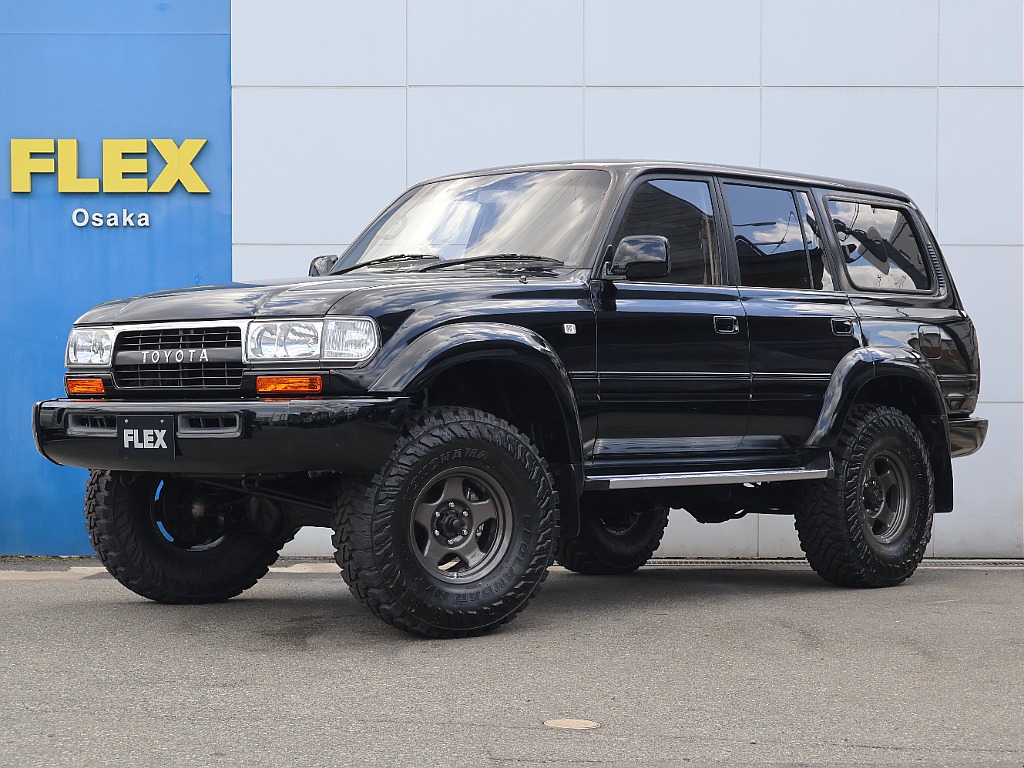
Our Land Cruiser 80 inventory comes from FLEX’s network in Japan, where the company has specialized in Land Cruisers for decades. Each truck is imported under the 25-year rule, cleared through US customs with the DOT and EPA import declarations, and offered through our San Diego store, with delivery available to buyers anywhere in the US. Prices on our listings exclude shipping and other fees, which vary by your state of residence; use the Get Total Estimate button on each listing for a quote. If you want a specific year, grade or engine that is not in stock, we can source it.
Used LX450 and FZJ80 Inspection Checklist
Our 80 Series buying checklist goes deeper on the chassis; these are the items specific to the LX450-versus-FZJ80 decision.
- Verify factory lockers by the dial on the dash and the actuators on both differentials, not by the switch alone.
- Ask for the head gasket history. On a 1993–1994 truck without a documented replacement, budget for one.
- Check the knuckles for grease weeping past the seals and ask when they were last rebuilt.
- Look for rust at the roof rack mounts, rear quarters, rear window frame, rear crossmember and spare tire area.
- Inspect the radiator end tanks and check the coolant for ATF contamination.
- Drive it in tight circles on pavement to feel for viscous coupler binding.
- Note every warning light; ABS and airbag lights are usually cheap sensors, but make the seller fix them.
- On an LX450, confirm the headlights, cladding and wheels are intact, because those are the parts a Toyota dealer cannot supply.
- Run the VIN through the NHTSA recall lookup and pull an AutoCheck or Carfax report.
- For a JDM truck, confirm the month of manufacture, get copies of the HS-7, 3520-1 and customs entry, and check your state’s rules before paying a deposit.
FAQs
Is the Lexus LX450 the same as the Land Cruiser?
Mechanically, yes. The 1996–1997 LX450 shares its body, frame, 212-horsepower 1FZ-FE engine, automatic transmission and full-time four-wheel drive with the 1995–1997 Land Cruiser. Lexus added its own grille, headlamps, cladding, wheels, standard leather and wood, automatic climate control and softer shocks.
How many Lexus LX450s were made?
Lexus’s specification sheets list 5,398 units for model year 1996 and 9,186 for 1997, about 14,600 in total. US sales were 7,528 in 1996 and 6,785 in 1997.
Does the LX450 have factory lockers?
Only if the original buyer paid $900 for them. Front and rear locking differentials were an option on both the LX450 and the 1993–1997 Land Cruiser and were never standard in the US.
Which 80 Series years are the best?
The mid-1995 through 1997 trucks have dual airbags, standard ABS and the A343F transmission, and the 1996–1997 trucks are fully OBD-II compliant. The 1993–1994 trucks offer the same engine for less money but carry the most head gasket reports. Our 80 Series Land Cruiser Buying Guide covers each year in detail.
Is the LX450 more reliable than the FZJ80?
No more and no less. The engine, transmission, axles and cooling system are the same, so reliability comes down to maintenance history and rust, not the badge.
How much is a Lexus LX450 worth in 2026?
Based on Bring a Trailer results over the past twelve months, honest drivers bring about $16,000–$24,000, sorted examples $24,000–$27,000, and the best trucks $33,000–$37,000, as of November 2026. Equivalent Land Cruisers generally sell for more.
Can I import a JDM 80 Series to the US?
Yes. Every 80 Series is now over 25 years old, so it can be imported under 49 CFR 591.5(i) with DOT form HS-7 and EPA form 3520-1. California requires a CARB laboratory test for gasoline models and does not allow diesel direct imports to be converted, so check your state before you buy.
Looking for a JDM of your dream?
As one of the top Land Cruiser vendors in Japan, our specialists will assist you to acquire your dream vehicles.


