

5 Common Problems With Toyota Tundra – Reliability Concerns & Fixes
Toyota Tundra is celebrated for its powerful performance, long-lasting durability, and class-leading towing capability. Yet no truck is perfect — and the Tundra is no exception. From classic issues like frame rust to the headline-grabbing engine recalls now affecting third-generation models, knowing what to watch for can save you thousands in repairs and keep you safe on the road.
This guide covers the five most common Toyota Tundra problems across all generations, with special attention to the latest V35A engine and transmission issues that have made news in 2024–2026.
Toyota Tundra Reliability: What Are the Common Concerns?
Overall, the Toyota Tundra earns strong reliability marks — a well-maintained example can last 150,000 to 300,000+ miles. However, certain model years and generations carry specific risks that every buyer should understand before signing a purchase agreement.
Common Reliability Issues
- Transmission problems (all generations; software recalls on 2022–2024)
- Frame rust and corrosion (especially pre-2022 models)
- Air injection pump failure (2007–2021 V8 engines)
- Exhaust manifold leaks (older V8 generations)
- V35A engine defects and recalls (2022–2024 third generation)
Photo by Toyota
The Latest Tundra Reliability Crisis: V35A Twin-Turbo V6 Engine Recalls (2022–2024)
The biggest reliability story for the current-generation Tundra centers on the 3.4-liter V35A twin-turbo V6 engine introduced in 2022. Toyota has issued safety recalls covering nearly 130,000 U.S. non-hybrid vehicles—the majority of them Tundra pickup trucks produced between late 2021 and early 2024.
What’s the problem? Machining debris left inside the engine during the manufacturing process can adhere to the main bearings over time. As the debris accumulates, it can cause engine knocking, a sudden loss of motive power while driving, or a complete engine stall, increasing the risk of a crash.
Recall Timeline & Remedy Strategy:
- May 2024 (24TA07): Initial recall covering approximately 102,000 model year 2022–2023 Tundra and Lexus LX600 vehicles.
- May 2026 Update: Expanded recall formally adding 2024 model year non-hybrid Tundra vehicles.
- The Official Remedy: Toyota uses specialized inspection software and vehicle drive data to evaluate the condition of the number one main bearing. If the software detects abnormal wear or cannot confirm the bearing is free from damage, dealers will replace the engine with a brand-new one FREE OF CHARGE.
Important notes:
- The i-Force MAX hybrid variant is not affected by this specific engine debris recall.
- 2026+ Models: Brand-new 2026 models benefit from an updated, sturdier main bearing designed to resist debris.
- Check your VIN at nhtsa.gov or contact your Toyota dealer immediately to see if your truck is listed.
What to do: If your vehicle is covered, Toyota will repair or replace the engine at no charge. Do not ignore symptoms like knocking, rough idle, or sudden power loss — towing your truck to a dealer is far safer than risking a highway stall.
1. Transmission Problems in the Toyota Tundra (Including 2022–2024 Models)
Transmission concerns have followed the Tundra across multiple generations. The current third-generation truck introduced a new 10-speed automatic that, while technically impressive, has been subject to its own recall.
Common Symptoms of Toyota Tundra Transmission Issues
- Jerky or delayed gear shifts
- Vehicle creeping forward unexpectedly when in neutral
- Sluggish acceleration or hesitation
- Overheating under heavy towing loads
- Torque converter shudder or total transmission failure (older models)
Reasons for Transmission Failures
- Software defect (2022–2024 models): A recall (code 24TA02) was issued for 2022–2024 Tundra and Tundra Hybrid, 2022–2024 Lexus LX600, and 2023–2024 Sequoia Hybrid vehicles. Certain transmission components may not fully disengage when shifted to neutral, allowing the vehicle to creep forward when no brakes are applied — a significant crash risk affecting approximately 268,600 U.S. vehicles.
- Outdated or degraded transmission fluid (all generations)
- Worn clutch packs or solenoids (high-mileage older models)
- Excessive towing beyond rated capacity
Transmission Repair and Warranty Solutions
For 2022–2024 models:
- If you haven’t already, visit a dealer to receive the free transmission control ECU software update (recall 24TA02). This addresses the neutral-position creep issue at no cost.
- Check for recall applicability using your VIN at nhtsa.gov or by calling Toyota at 1-800-331-4331.
For all generations:
- Replace transmission fluid every 60,000–100,000 miles using Toyota-specified ATF WS fluid.
- Have the torque converter, clutch packs, and solenoids inspected if shifting problems persist.
- Never tow beyond your truck’s rated capacity; if heavy towing is routine, consider an aftermarket transmission cooler.
- Inspect for red or brown fluid leaks near the transmission regularly, and replace the pan gasket or seals as needed.
2. Frame Rust and Corrosion in the Toyota Tundra
Frame rust has been one of the most serious and costly issues in Toyota Tundra history, particularly affecting first- and second-generation trucks (2000–2021) driven in northern states, coastal areas, or anywhere road salt is common. Severe corrosion can compromise structural integrity and lead to safety failures or inspection rejection.
Common Symptoms of Toyota Tundra Frame Corrosion and Rust
- Visible reddish-brown rust or flaking on the undercarriage frame
- Metal peeling or weakening at stress points
- Creaking or groaning sounds from the chassis
- Failure to pass state safety inspections
Causes of Frame Rust
- Earlier Tundra models used undercoating that proved insufficient against sustained moisture exposure
- Road salt in snow-belt states and salt air in coastal regions accelerate corrosion significantly
- Water trapped inside hollow frame sections promotes rust from the inside out
- Accumulated road debris holds moisture against metal surfaces
How to Prevent and Treat Frame Rust
- Wash the undercarriage regularly — especially after driving on salted roads — using a high-pressure rinse
- Apply rust-inhibiting undercoating (well-regarded options include POR-15, Fluid Film, and Eastwood Rust Encapsulator)
- Drill small drainage holes in frame sections where water tends to pool, if not already present from the factory
- Treat early-stage rust with a neutralizing product such as Rust-Oleum Rust Reformer before it spreads
- If rust has compromised structural integrity, consult a qualified body shop about welding or reinforcement — do not ignore load-bearing frame damage
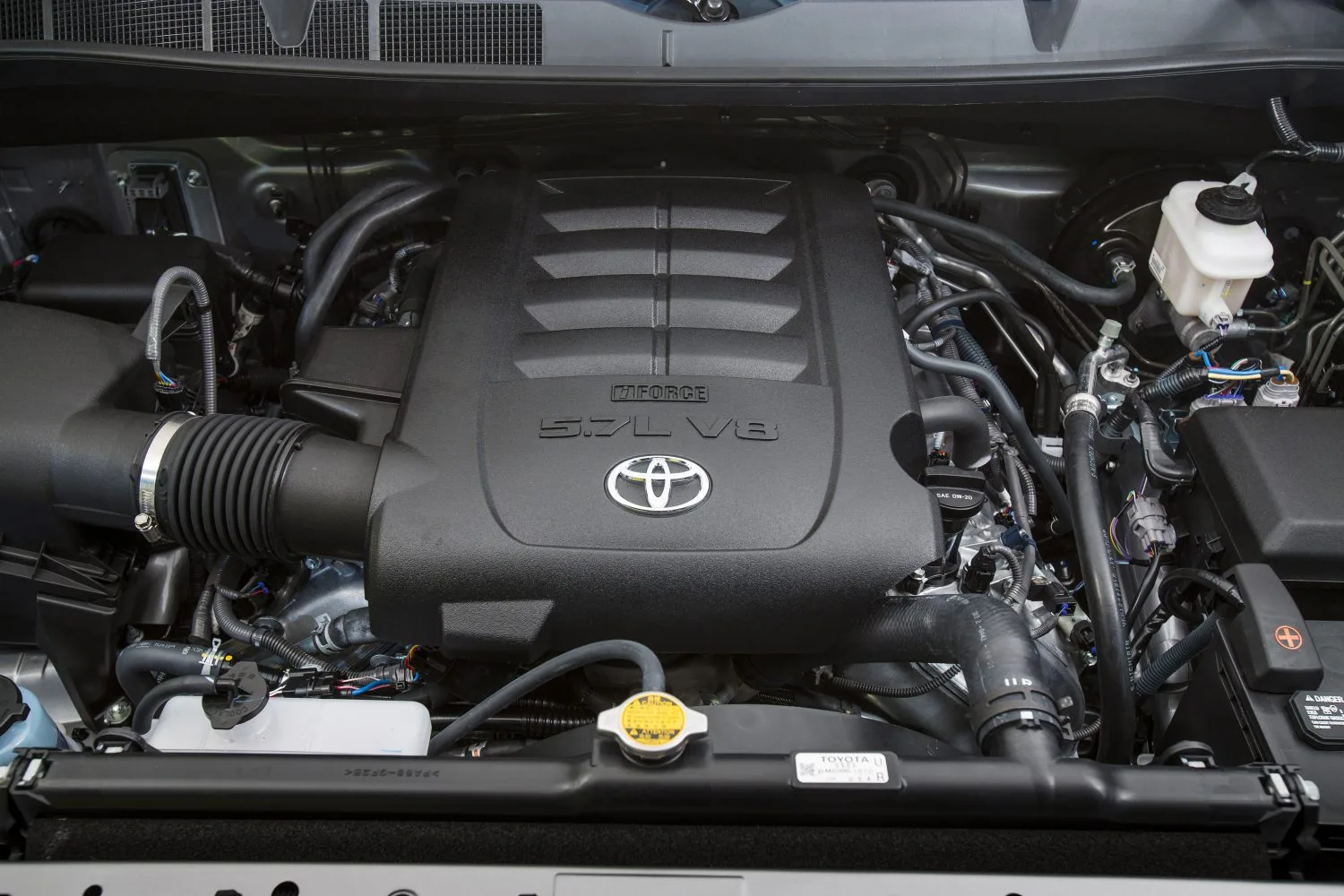
Photo by Toyota
3. Air Injection Pump Failure in the Toyota Tundra
Premature air injection pump (AIR pump) failure is a well-documented issue on first- and second-generation Tundras equipped with the 5.7L or 4.7L V8 engine (approximately 2007–2021). The AIR pump reduces cold-start emissions by injecting fresh air into the exhaust system during warm-up. When it fails, the truck often enters limp mode, restricting power and speed.
Common symptoms:
- Check Engine light (typically P0410 or related codes)
- Rough running during cold starts
- Vehicle enters reduced-power limp mode
Causes: Moisture intrusion into the pump or control valves leads to electrical failure and corrosion. Carbon buildup from exhaust gases also degrades the pump over time.
Solutions:
- Replacing the pump and valves through a dealer typically costs over $4,000. Some owners opt for an aftermarket air pump bypass kit as a more affordable alternative, though this may affect emissions compliance depending on your state.
- Using premium gasoline and avoiding short cold-weather trips can slow carbon buildup and extend pump life.
- Regular inspection of the AIR pump system, especially in humid or cold climates, helps catch early failure before limp mode occurs.
4. Exhaust Manifolds Leaks – Symptoms and Repair Solutions
Exhaust manifold leaks are a recurring complaint on older V8-powered Tundras, particularly those with high mileage or driven in areas with extreme temperature swings. Repeated heat cycles cause the manifold metal to expand and contract, eventually cracking the manifold itself or degrading the gasket seal.
Symptoms:
- Ticking or tapping sound from the engine bay, most noticeable when cold
- Burning smell or visible exhaust smoke near the engine
- Reduced fuel economy and power
- Possible emissions test failure
Solutions:
- Replace a worn or blown gasket with a high-quality heat-resistant replacement to seal the leak
- If cracks are found in the manifold itself, repair or replace the manifold — a cracked manifold cannot be reliably patched long-term
- Consider ceramic-coated or upgraded aftermarket manifolds to better resist thermal stress
- Inspect the exhaust system for leaks at every major service interval, particularly after 100,000 miles
Photo by Toyota
Final Thoughts
The Toyota Tundra remains one of the most capable and durable full-size pickup trucks on the market. However, the third-generation (2022+) has introduced new challenges — most critically the ongoing V35A engine recall and the transmission software recall — that represent a significant departure from the bulletproof reputation built by earlier V8-powered models.
Quick generation summary:
- 1st/2nd gen (2000–2021): Watch for frame rust, AIR pump failure, exhaust manifold leaks, and high-mileage transmission wear
- 3rd gen (2022–2024): Prioritize checking recall status for the V35A engine (24TA07) and the transmission software (24TA02). Both are handled free of charge by Toyota dealers, though engine claims now require a software-based inspection.
Regardless of model year, staying on top of fluid changes, undercarriage inspections, and recall notifications is the best way to keep your Tundra running strong for years to come.
FAQs
Are Toyota Tundra trucks reliable?
Yes — particularly first- and second-generation trucks with the 5.7L V8, which routinely exceed 200,000–300,000 miles with proper maintenance. Third-generation models (2022–2024) have faced significant recall challenges centered on the V35A twin-turbo V6 engine and transmission software, which has raised concerns among buyers. Toyota is addressing these issues through free software updates and diagnostic-driven engine replacements.
What is the most common problem with a Toyota Tundra?
Historically, frame rust (especially in salt-belt states) and transmission wear have been the most widespread concerns. For current-generation trucks, the V35A engine machining debris recall (covering 2022–2024 non-hybrid models) and the neutral-position transmission software recall are the issues most frequently reported and searched by owners.
Has Toyota fixed the recent Tundra engine problems?
Yes, for newer production runs. Toyota has implemented additional manufacturing controls and equipped later models (including the 2026 Tundra) with an improved number one main bearing designed to resist debris. For affected 2022–2024 non-hybrid models, Toyota’s remedy utilizes advanced diagnostic and acoustic software at dealerships to inspect the main bearings. If any signs of premature wear or debris damage are flagged by the software, Toyota will replace the entire engine at no cost. The i-Force MAX hybrid variant remains unaffected.
Don’t Just Look — Feel the Drive
Take your favorite model for a spin through the streets of San Diego. Feel the performance firsthand.